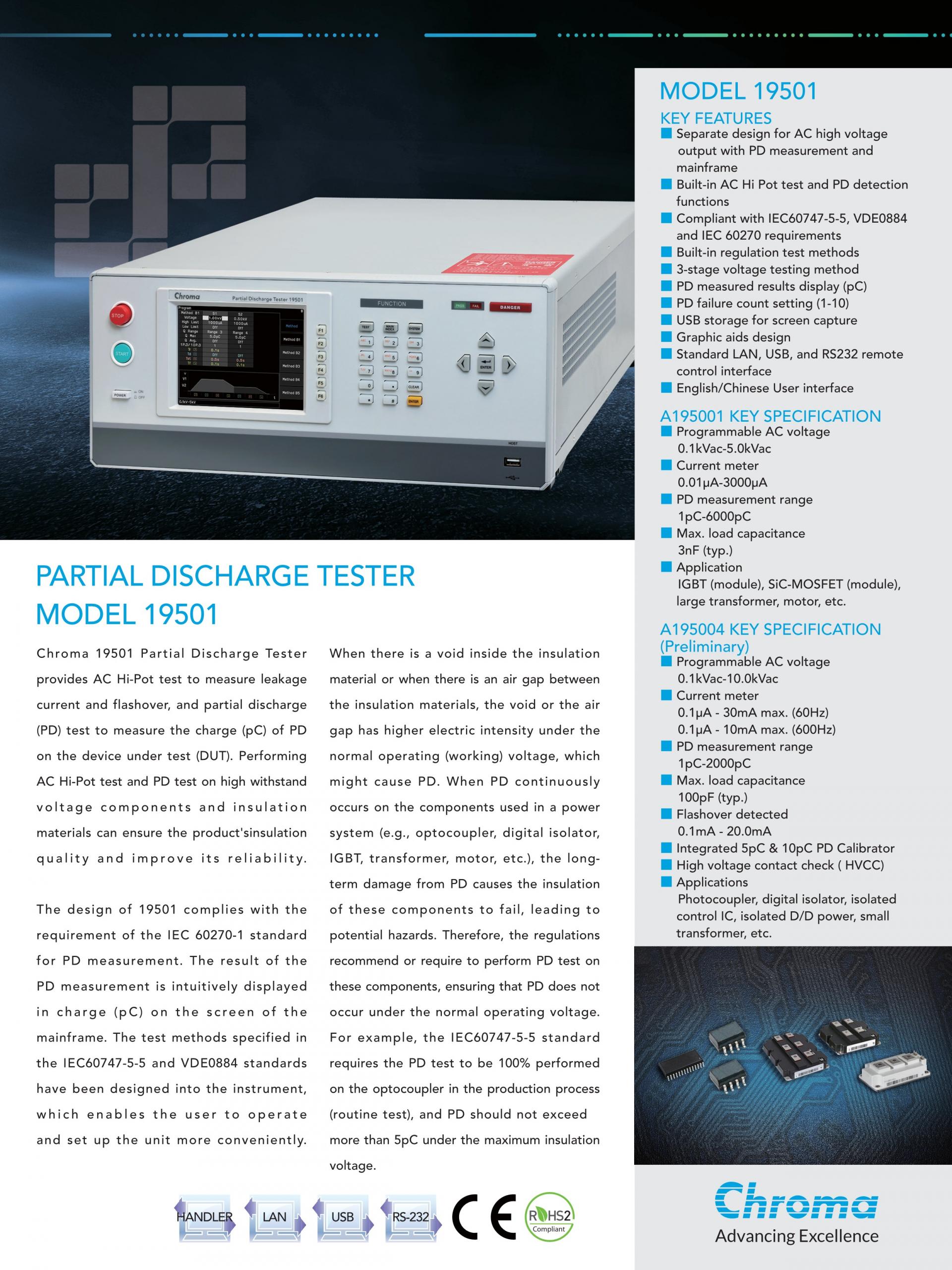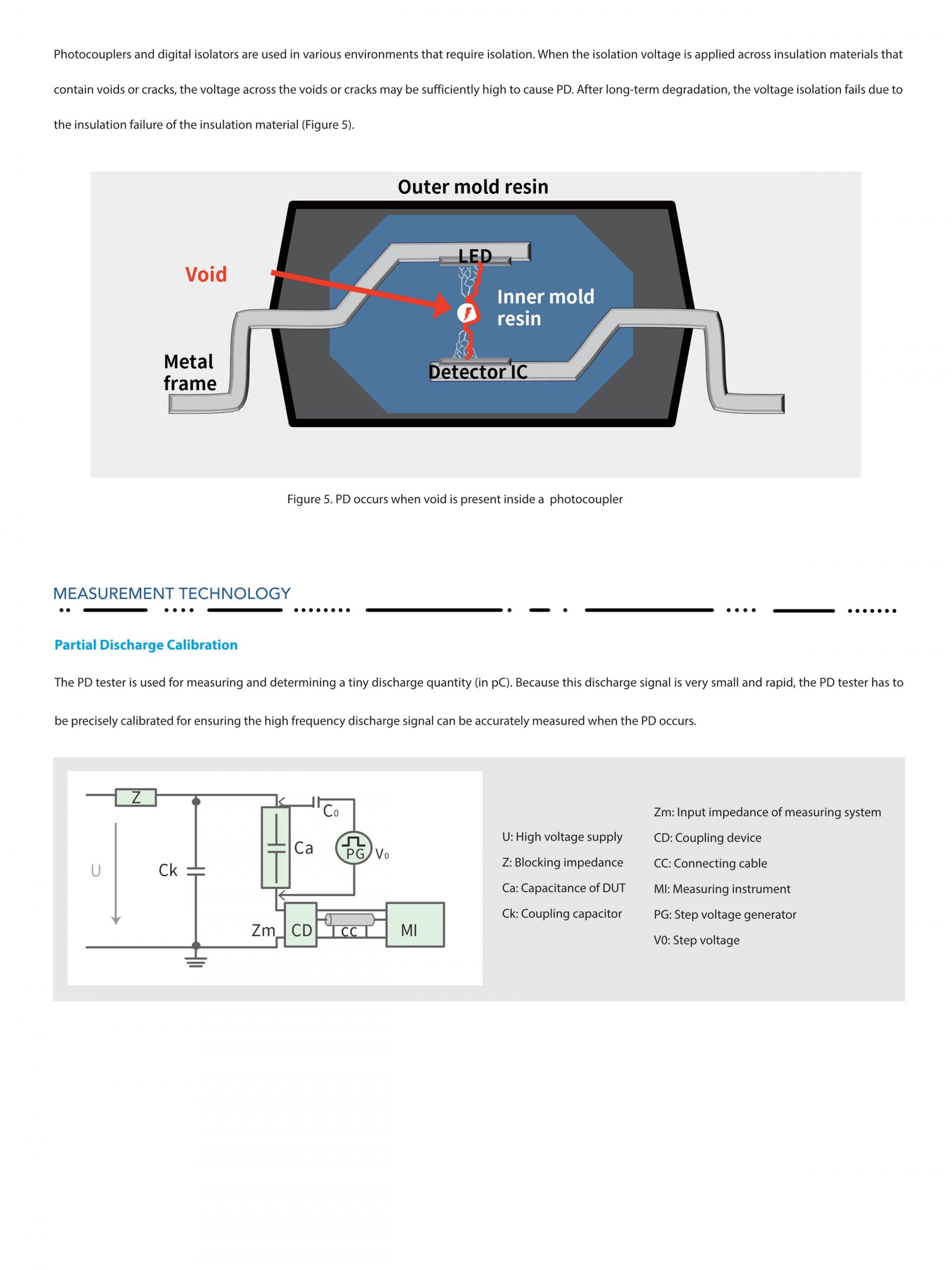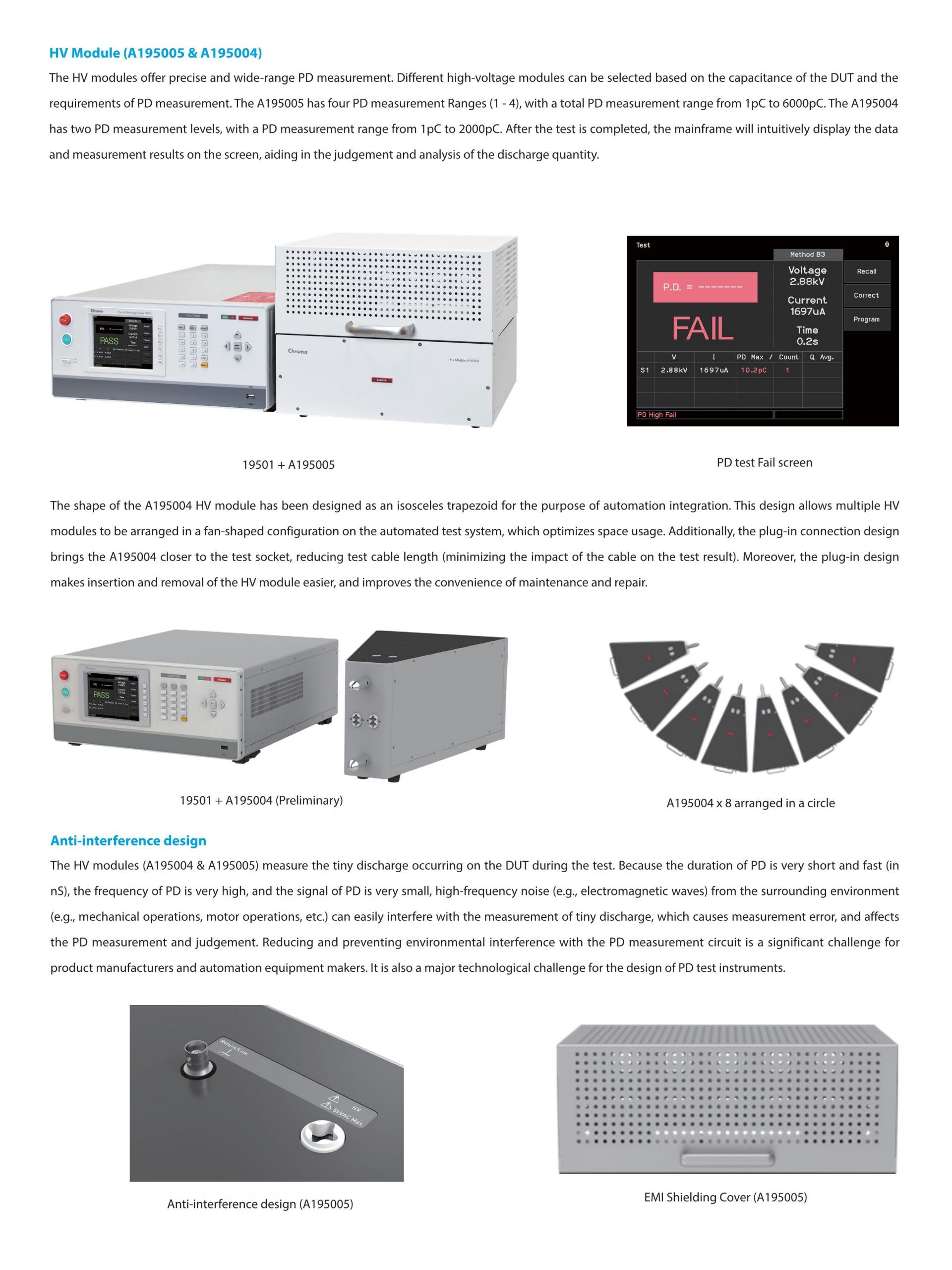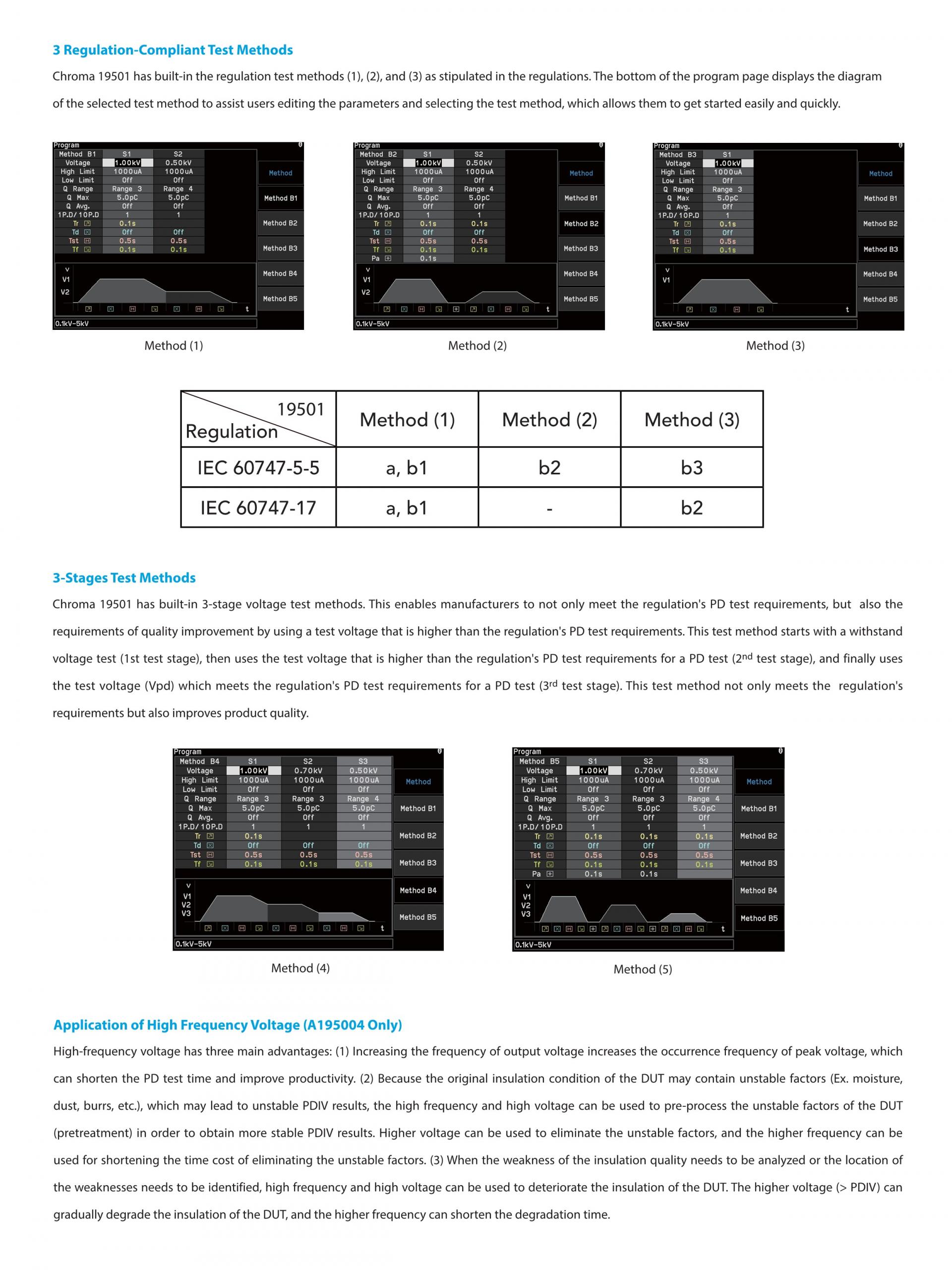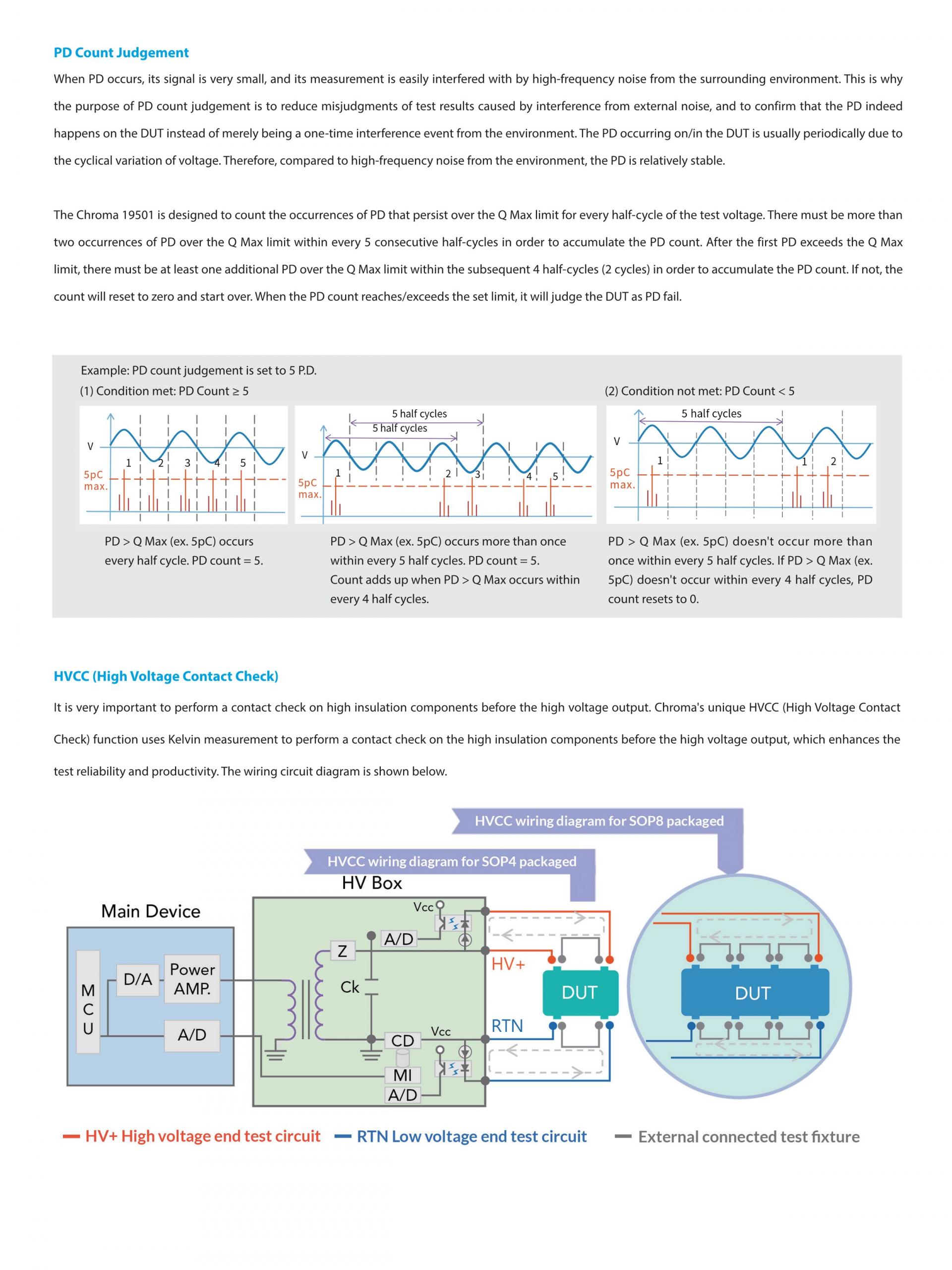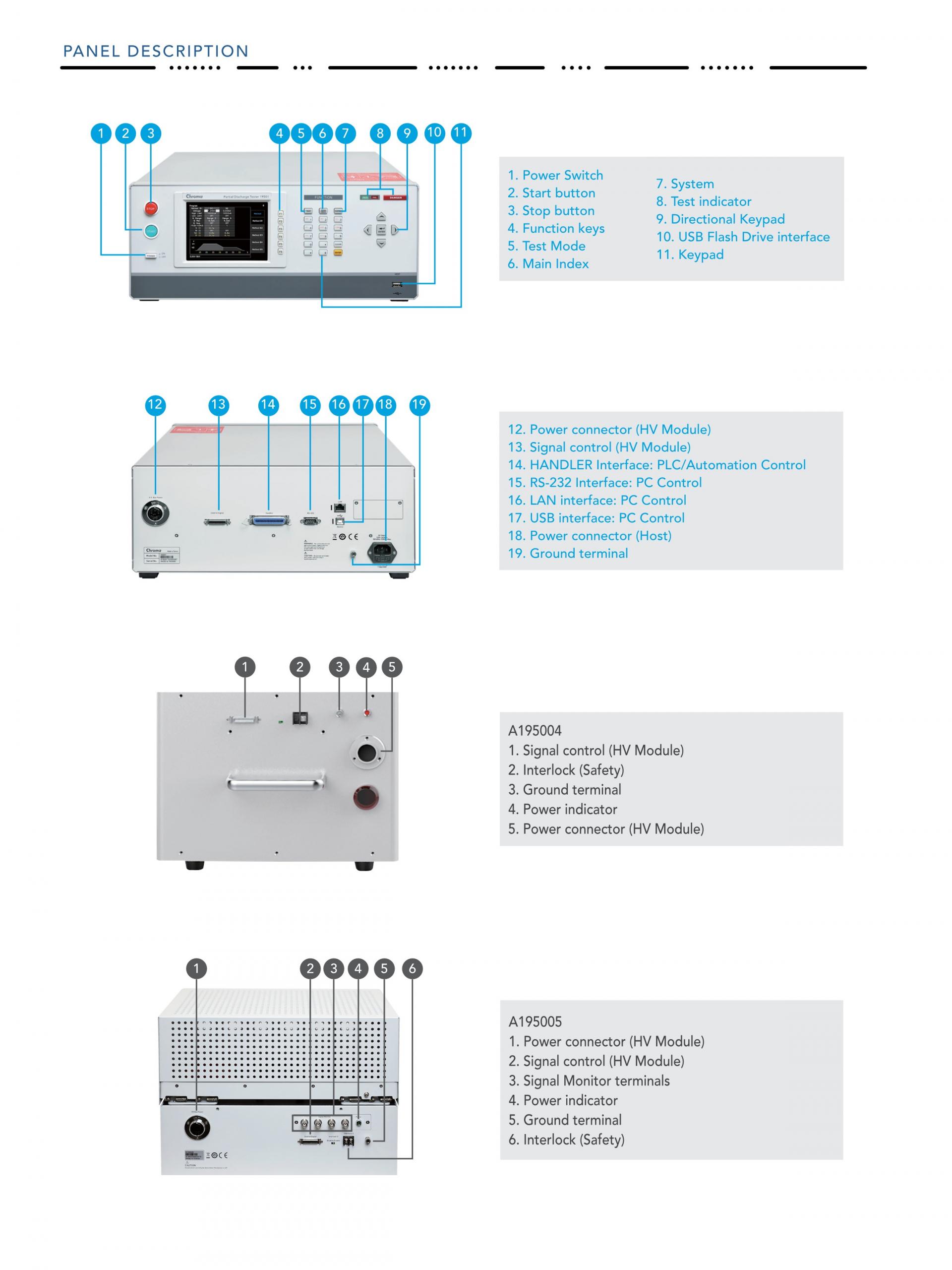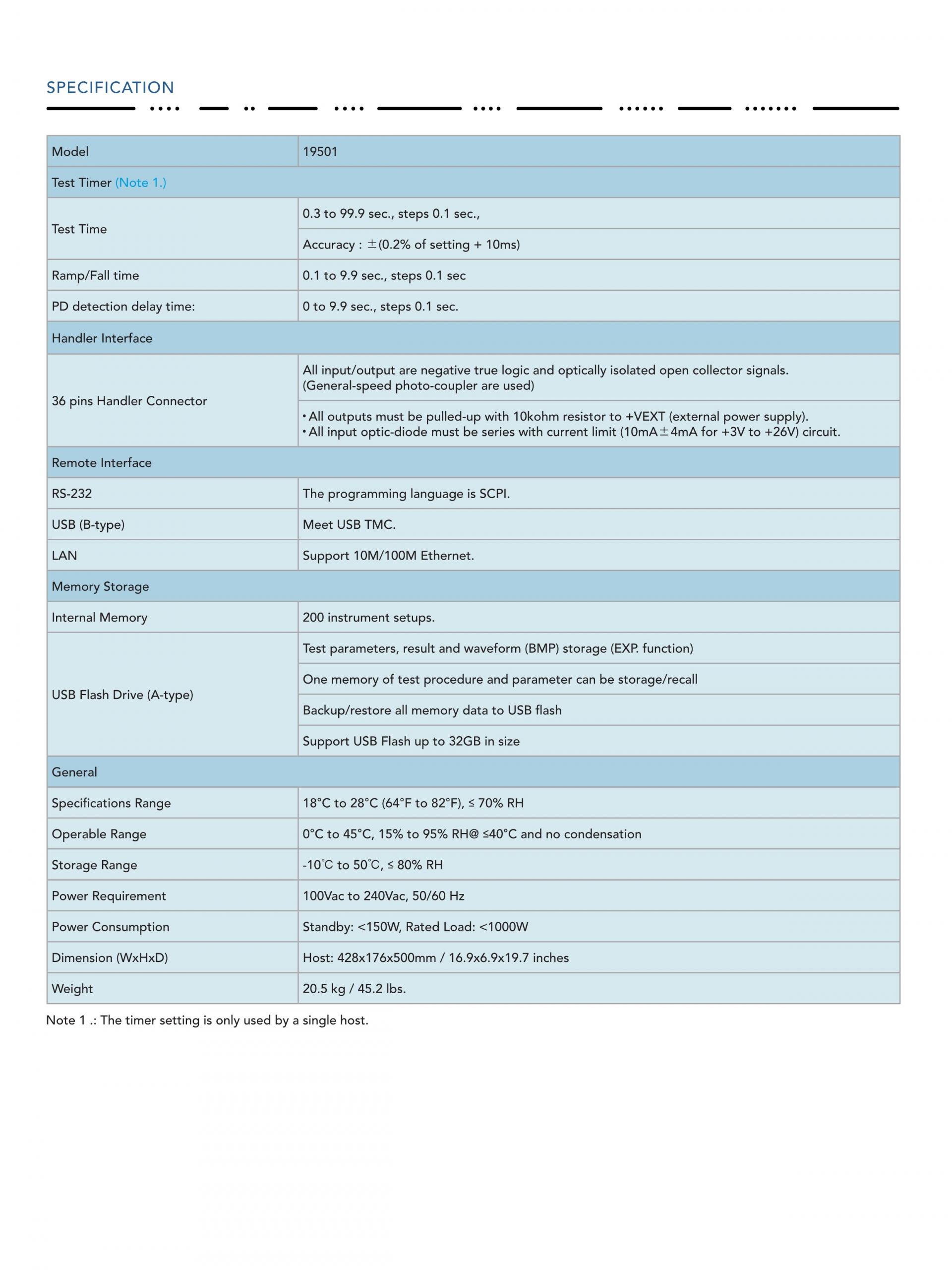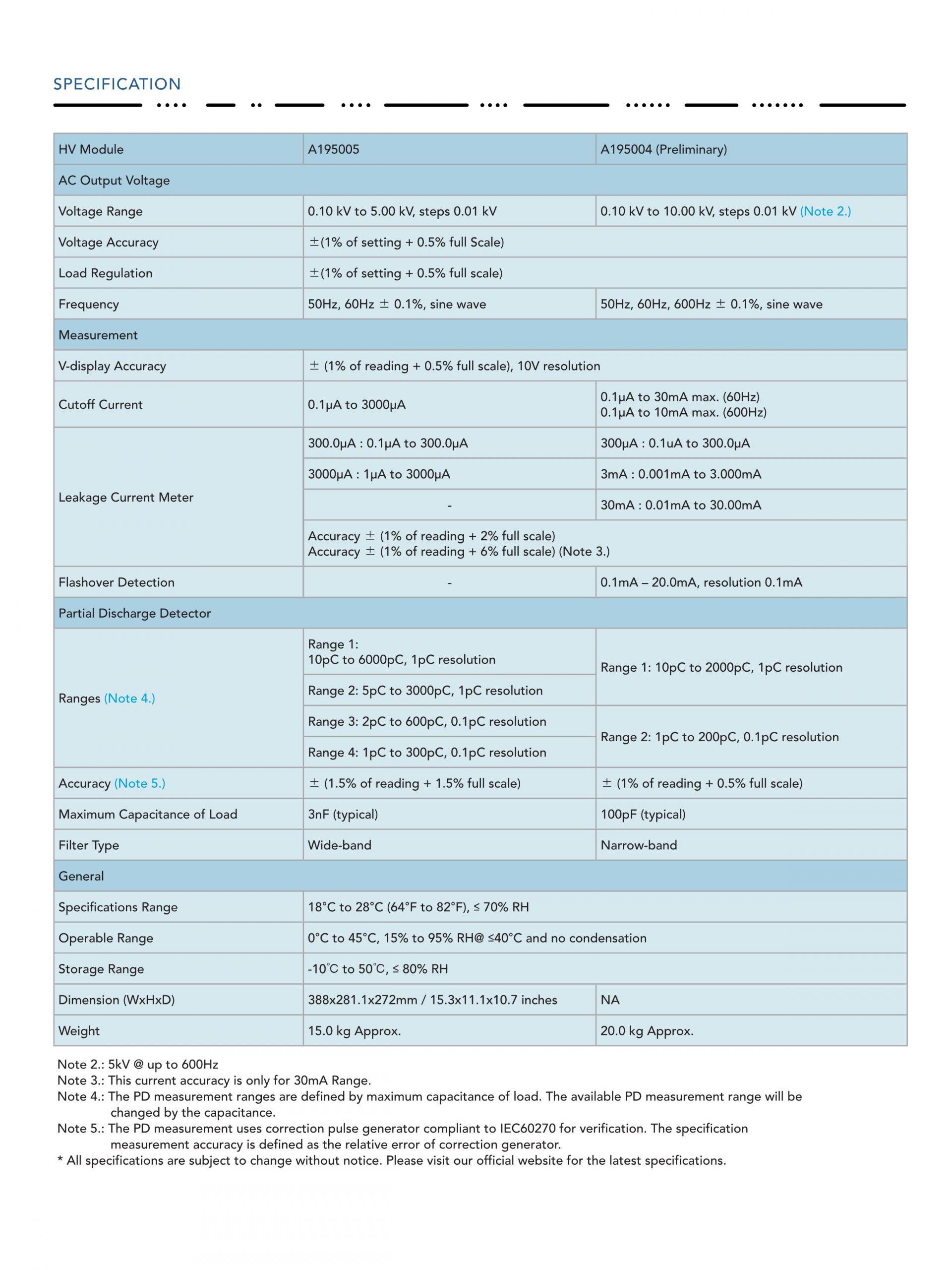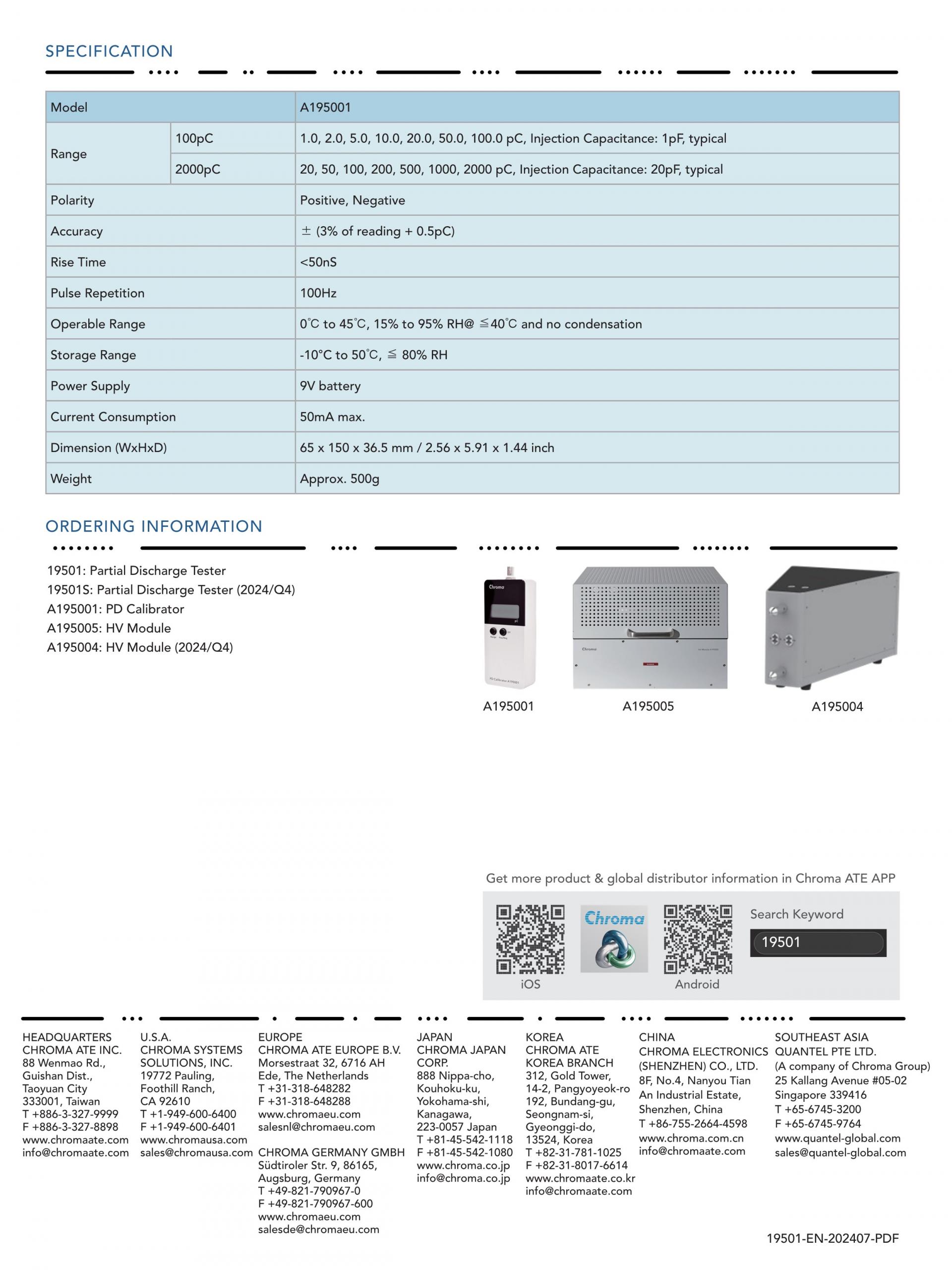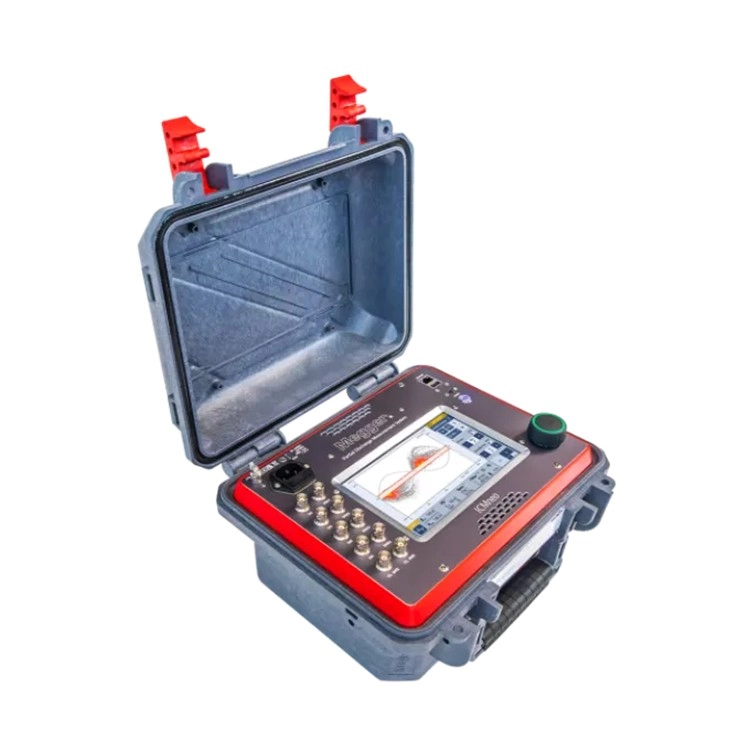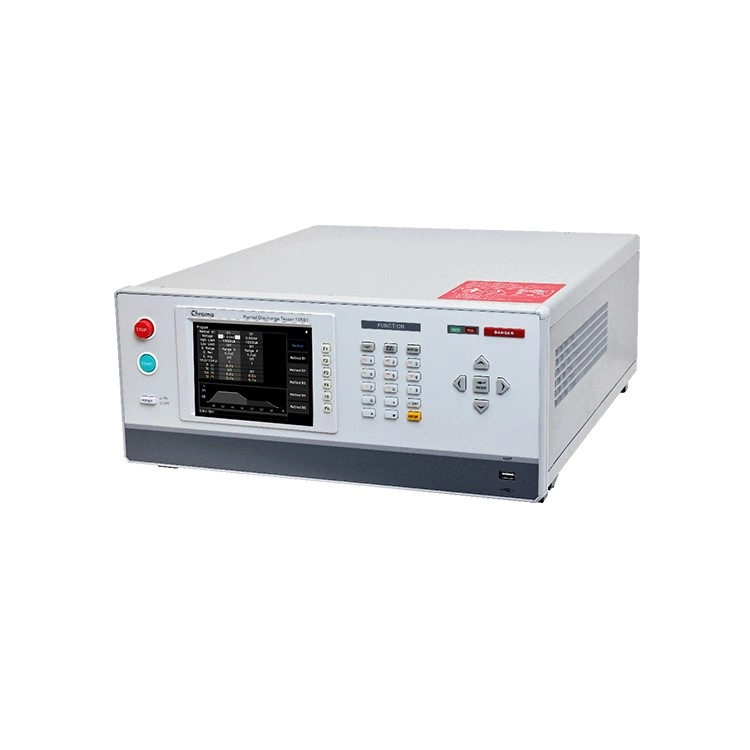
Chroma 19501 Partial Discharge Tester provides AC Hi-Pot test to measure leakage current and flashover, and partial discharge (PD) test to measure the charge (pC) of PD on the device under test (DUT). Performing AC Hi-Pot test and PD test on high withstand voltage components and insulation materials can ensure the product's insulation quality and improve its reliability.
| 원산지 | TAIWAN |
|---|---|
| 제조사 | CHROMA |
| 브랜드 | CHROMA |
| 무게 | 1kg |
Chroma 19501 Partial Discharge Tester provides AC Hi-Pot test to measure leakage current and flashover, and partial discharge (PD) test to measure the charge (pC) of PD on the device under test (DUT). Performing AC Hi-Pot test and PD test on high withstand voltage components and insulation materials can ensure the product's insulation quality and improve its reliability.
The design of 19501 complies with the requirement of the IEC 60270-1 standard for PD measurement. The result of the PD measurement is intuitively displayed in charge (pC) on the screen of the mainframe. The test methods specified in the IEC60747-5-5 and VDE0884 standards have been designed into the instrument, which enables the user to operate and set up the unit more conveniently.
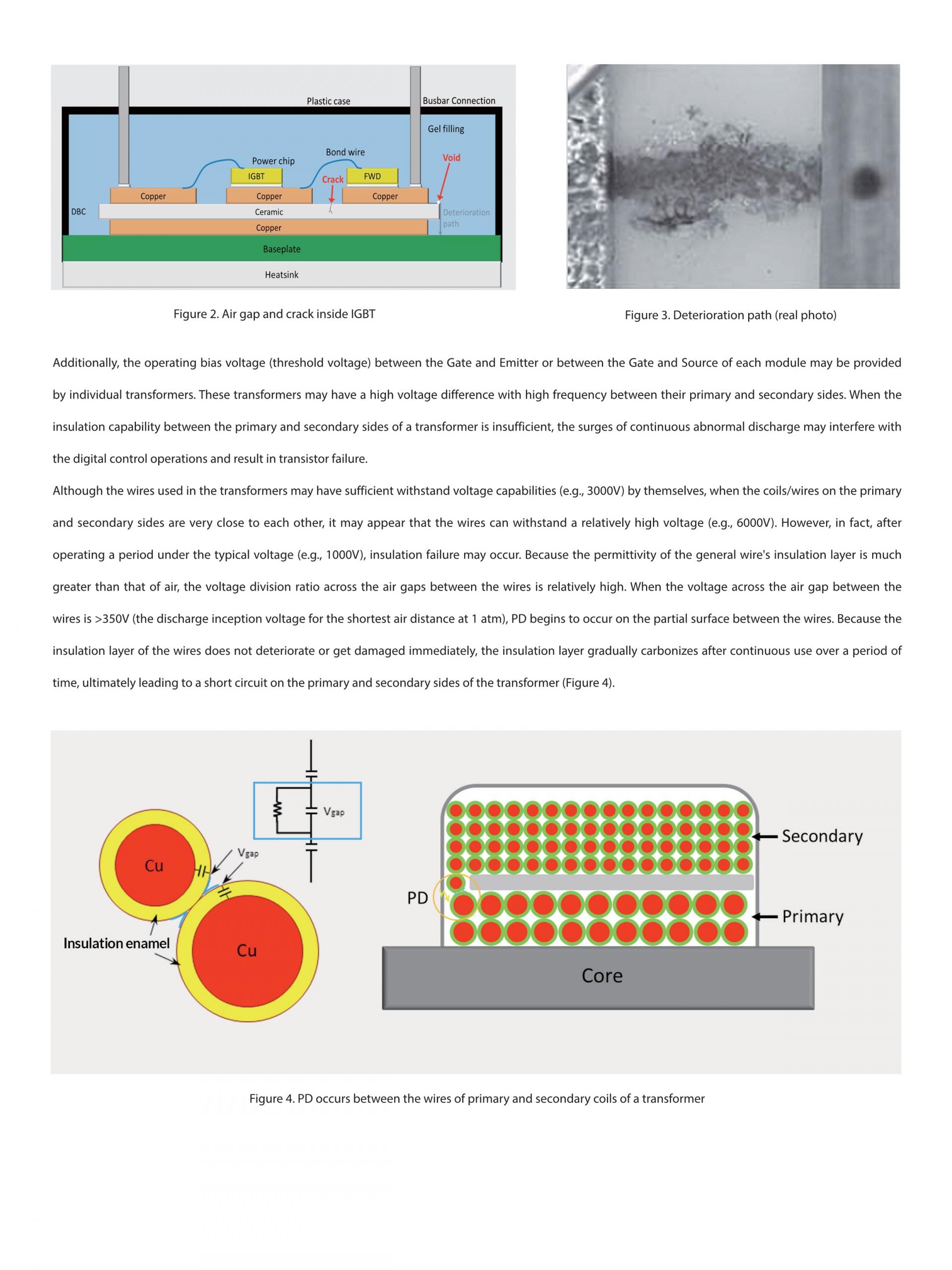
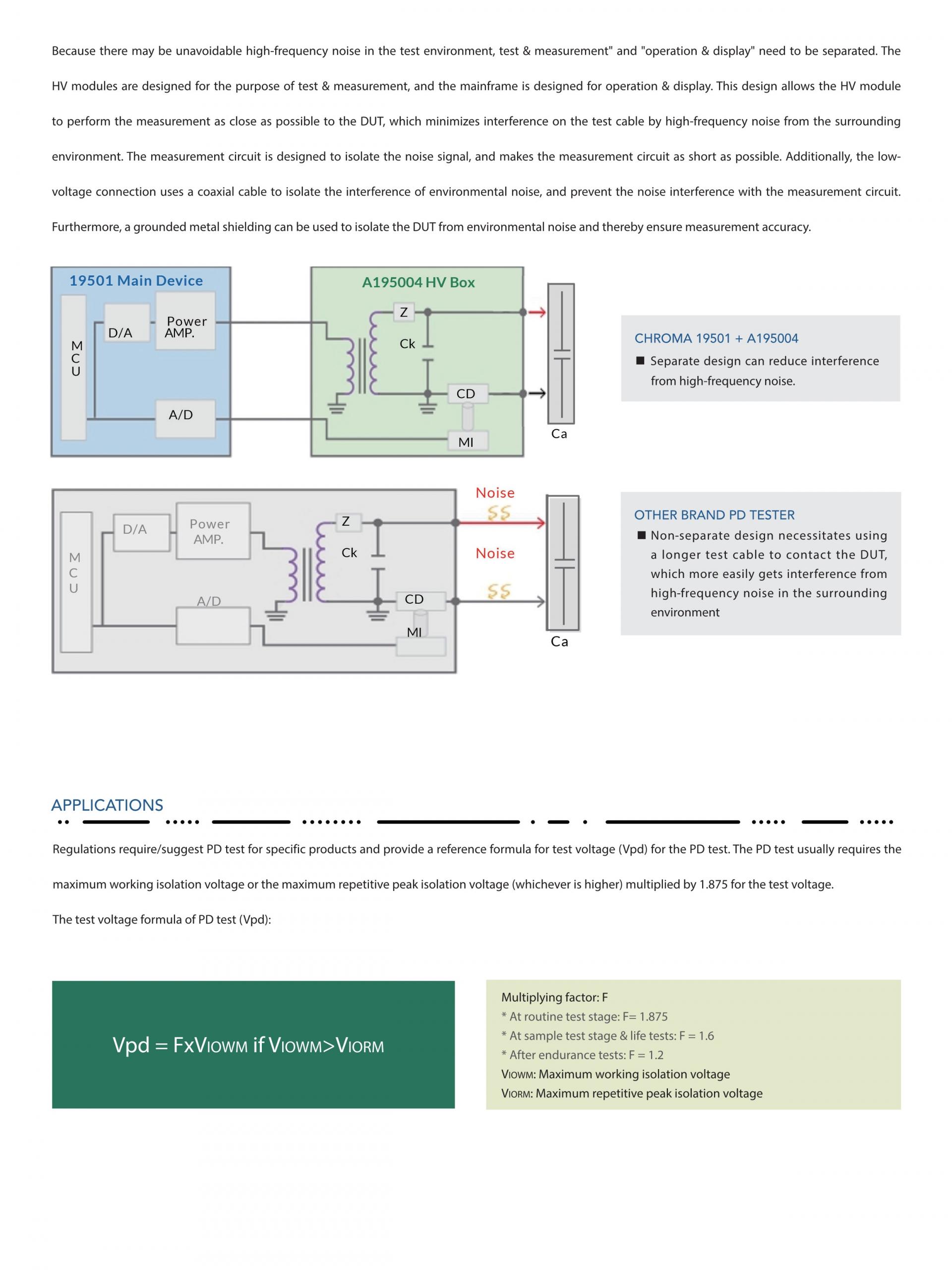
When there is a void inside the insulation material or when there is an air gap between the insulation materials, the void or the air gap has higher electric intensity under the normal operating (working) voltage, which might cause PD. When PD continuously occurs on the components used in a power system (e.g., optocoupler, digital isolator, IGBT, transformer, motor, etc.), the longterm damage from PD causes the insulation of these components to fail, leading to potential hazards. Therefore, the regulations recommend or require to perform PD test on these components, ensuring that PD does not occur under the normal operating voltage. For example, the IEC60747-5-5 standard requires the PD test to be 100% performed on the optocoupler in the production process (routine test), and PD should not exceed more than 5pC under the maximum insulation voltage.
Partial Discharge
When there is a void inside the insulation material or when there is an air gap between the insulation materials, the void or the air gap is prone to partial discharge (PD) under the normal operating (working) voltage, which can lead to insulation degradation and cause the insulation quality to be abnormal. Why does PD often appear at the voids inside the epoxy or the air gap between enameled wires? Because the relative permittivity of air is a lower than that of the insulation material, the capacitance of the void or air gap is lower than that of the insulating material, and therefore, the void or air gap will have a relatively high proportion of voltage. Additionally, under the same distance condition, the breakdown voltage of the void or air gap is lower than that of the insulation material. This electrical discharge, which occurs in the void or air gap (partial defects) while other insulation materials in series are remaining normal, is called partial discharge (PD).
When a sufficient test voltage is applied on the device under test (DUT), the charge quantity of PD is measured (in pC) by using PD measurement for checking whether the insulation material of the DUT has any potential risk of abnormal insulation quality. Therefore, applying the test voltage, which is slightly higher than the maximum rated working voltage of the component, for the PD test ensures the component's quality and reliability (no continuous PD) for long-term operation under normal operating voltage.
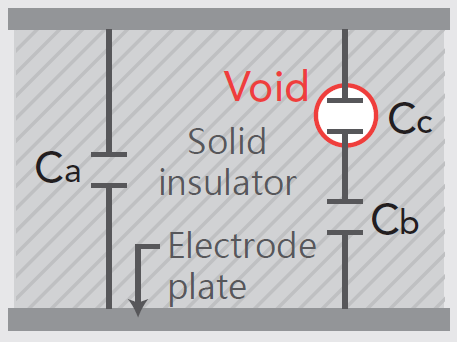
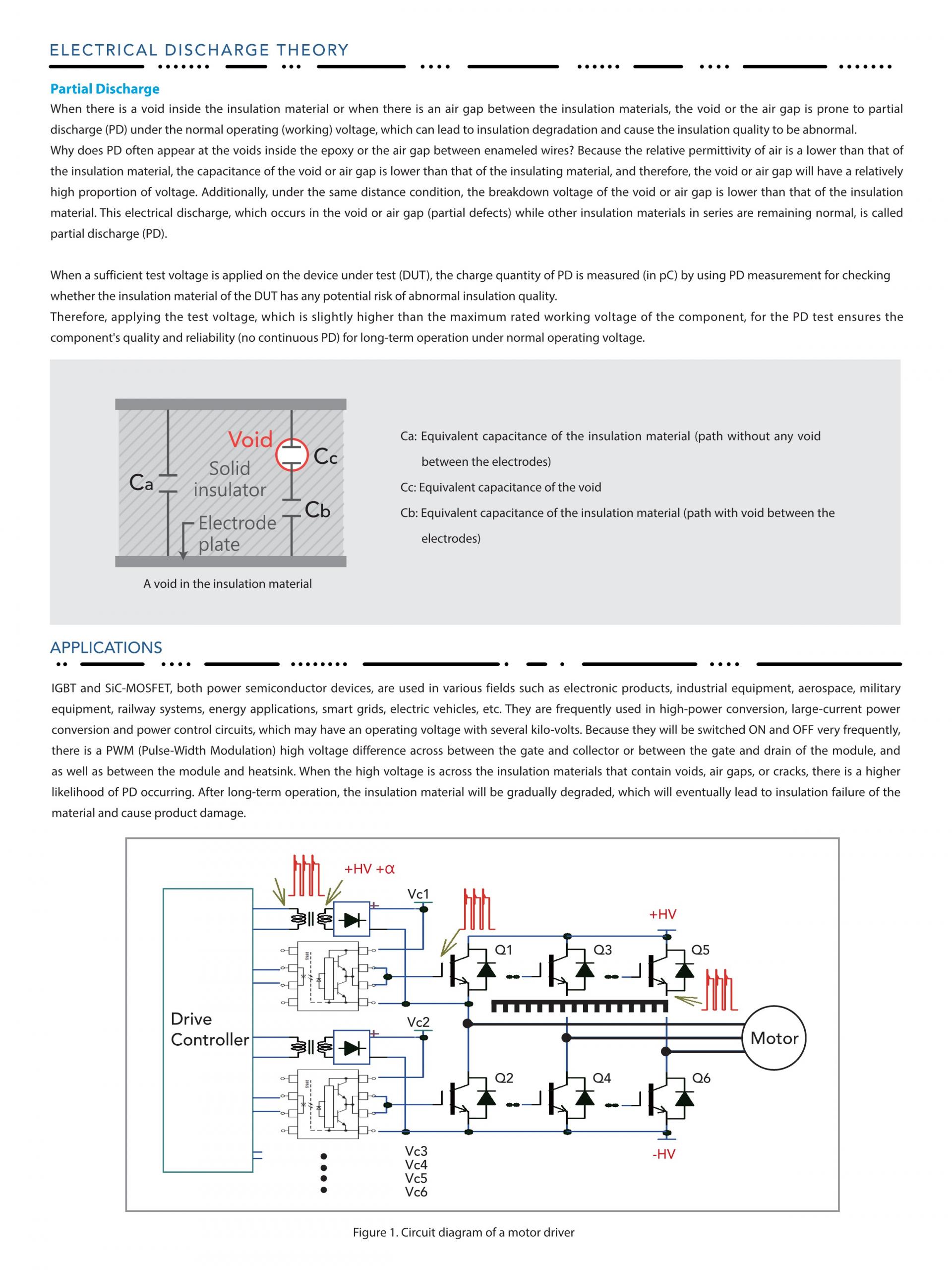
A void in the insulation material
Ca: Equivalent capacitance of the insulation material (path without any void between the electrodes)
Cc: Equivalent capacitance of the void
Cb: Equivalent capacitance of the insulation material (path with void between the electrodes)