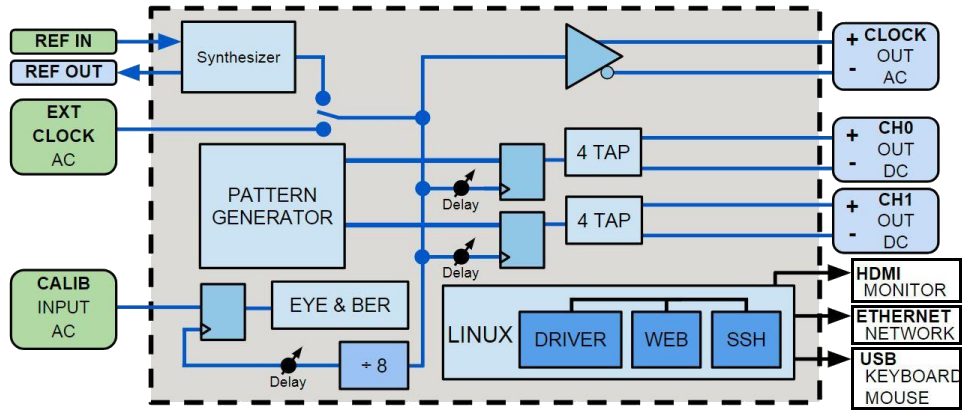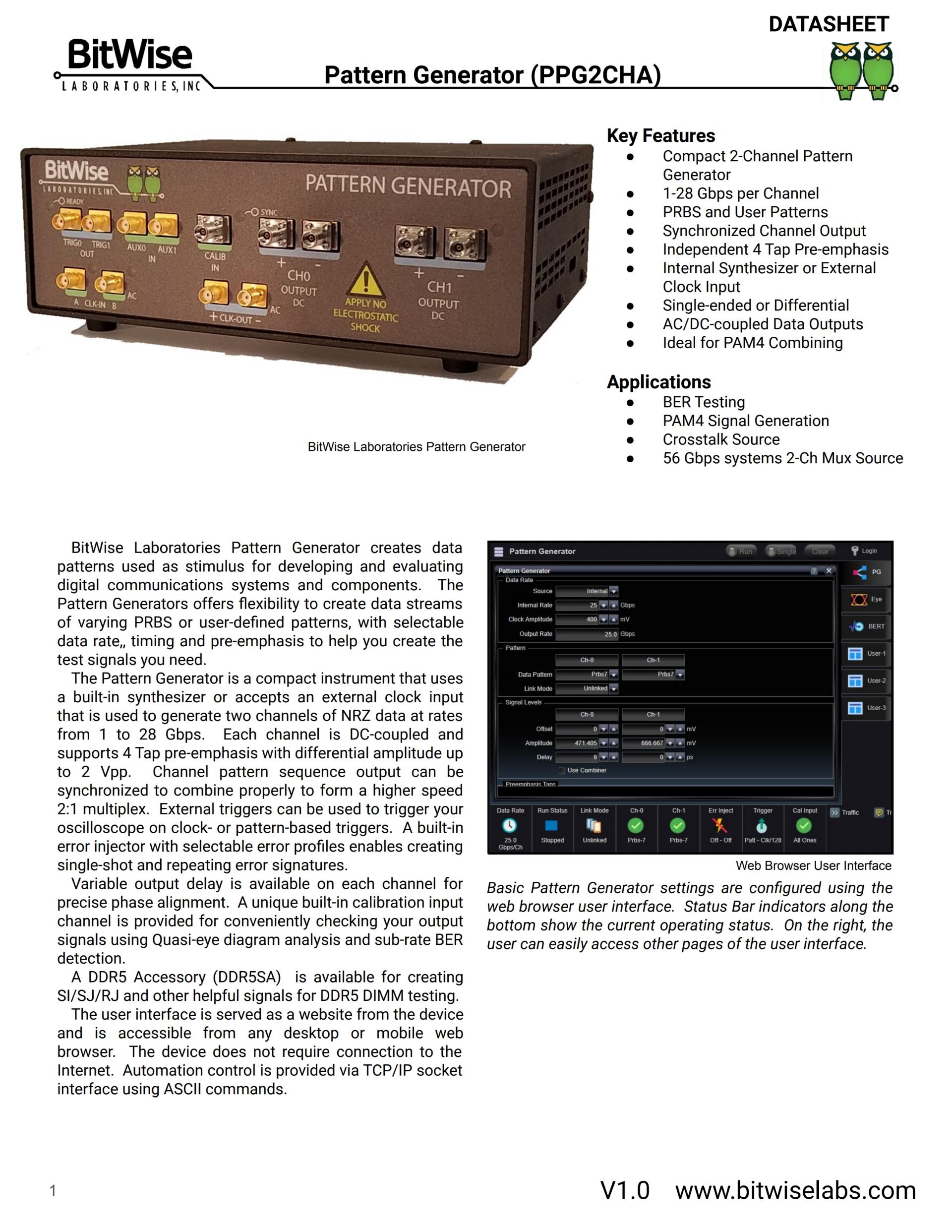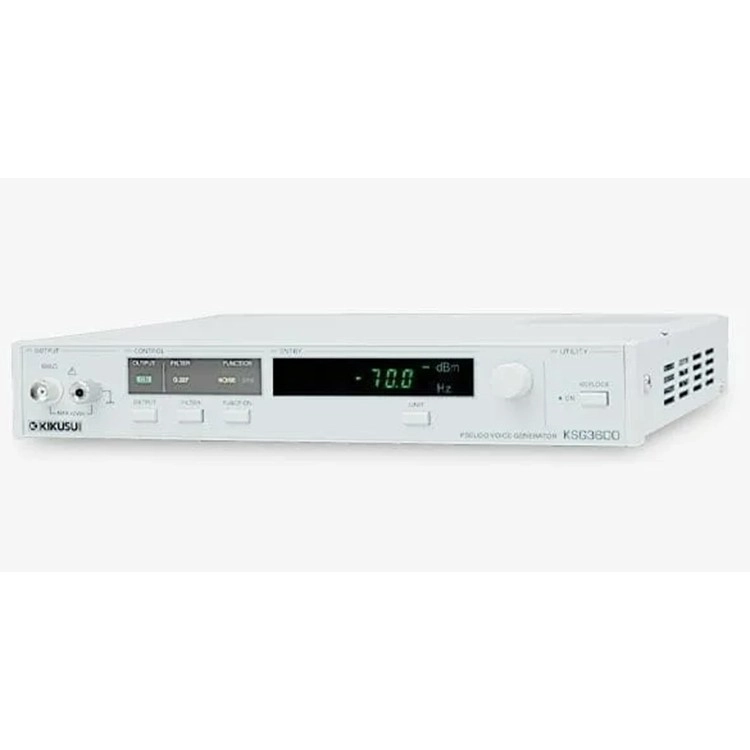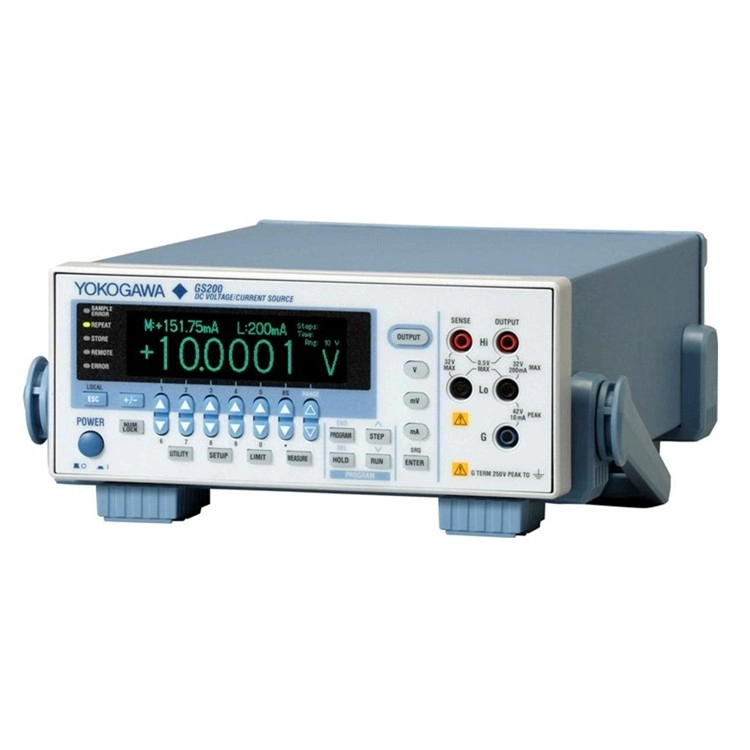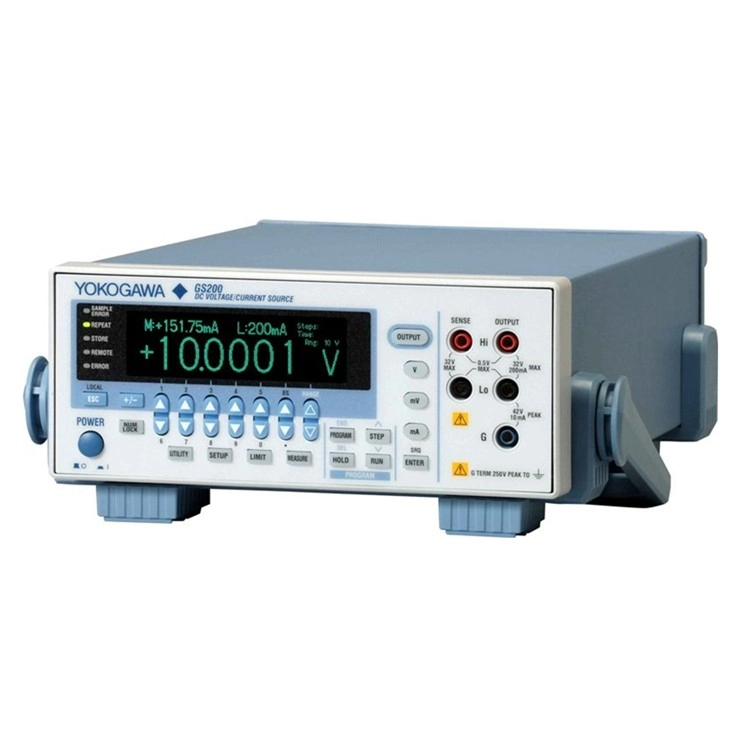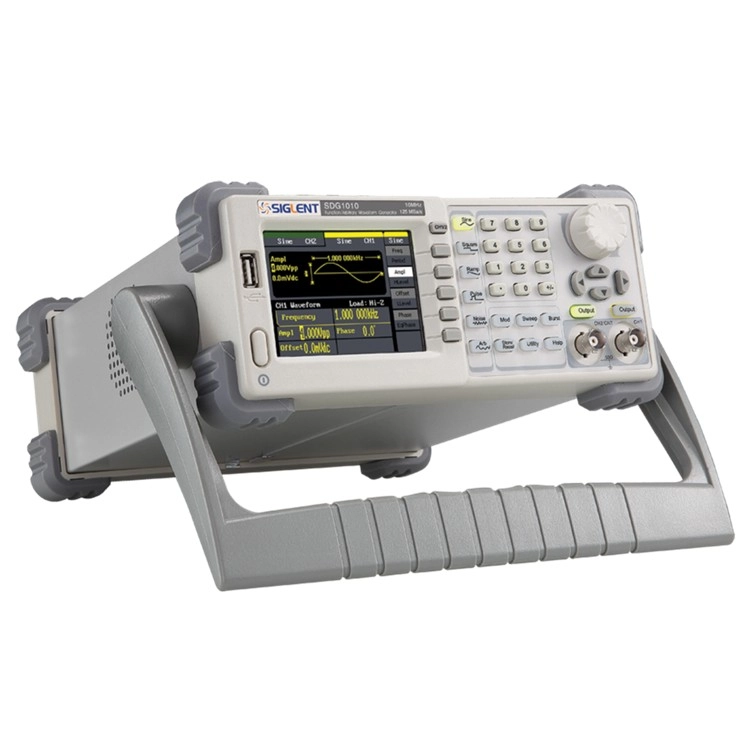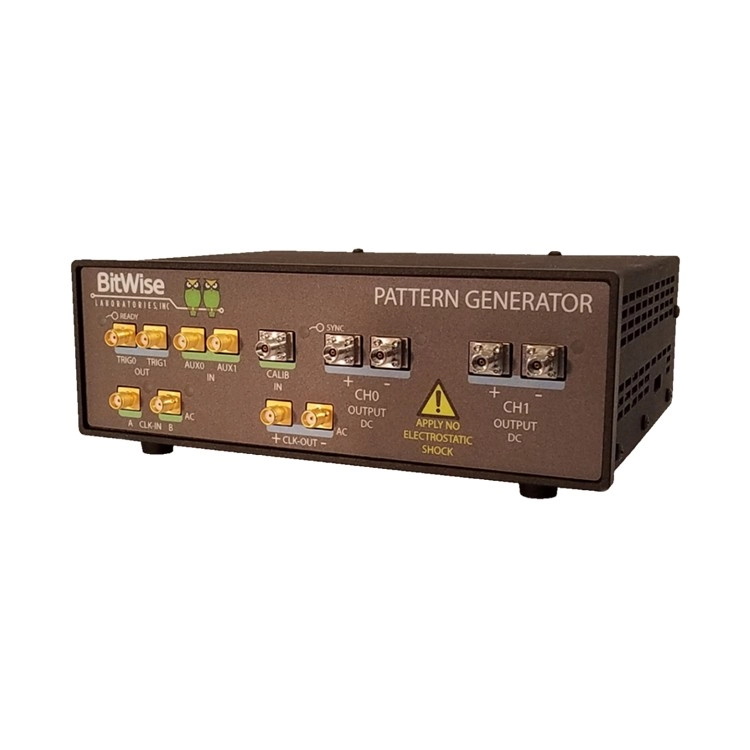
The Pattern Generator creates data patterns used as stimulus for developing and evaluating digital communications systems and components. The Pattern Generators offers flexibility to create data streams of varying PRBS or user-defined patterns, with selectable data rate,, timing and pre-emphasis to help you create the test signals you need.
| 원산지 | USA |
|---|---|
| 제조사 | BITWISE |
| 브랜드 | BITWISE |
| 무게 | 1kg |
Key Features
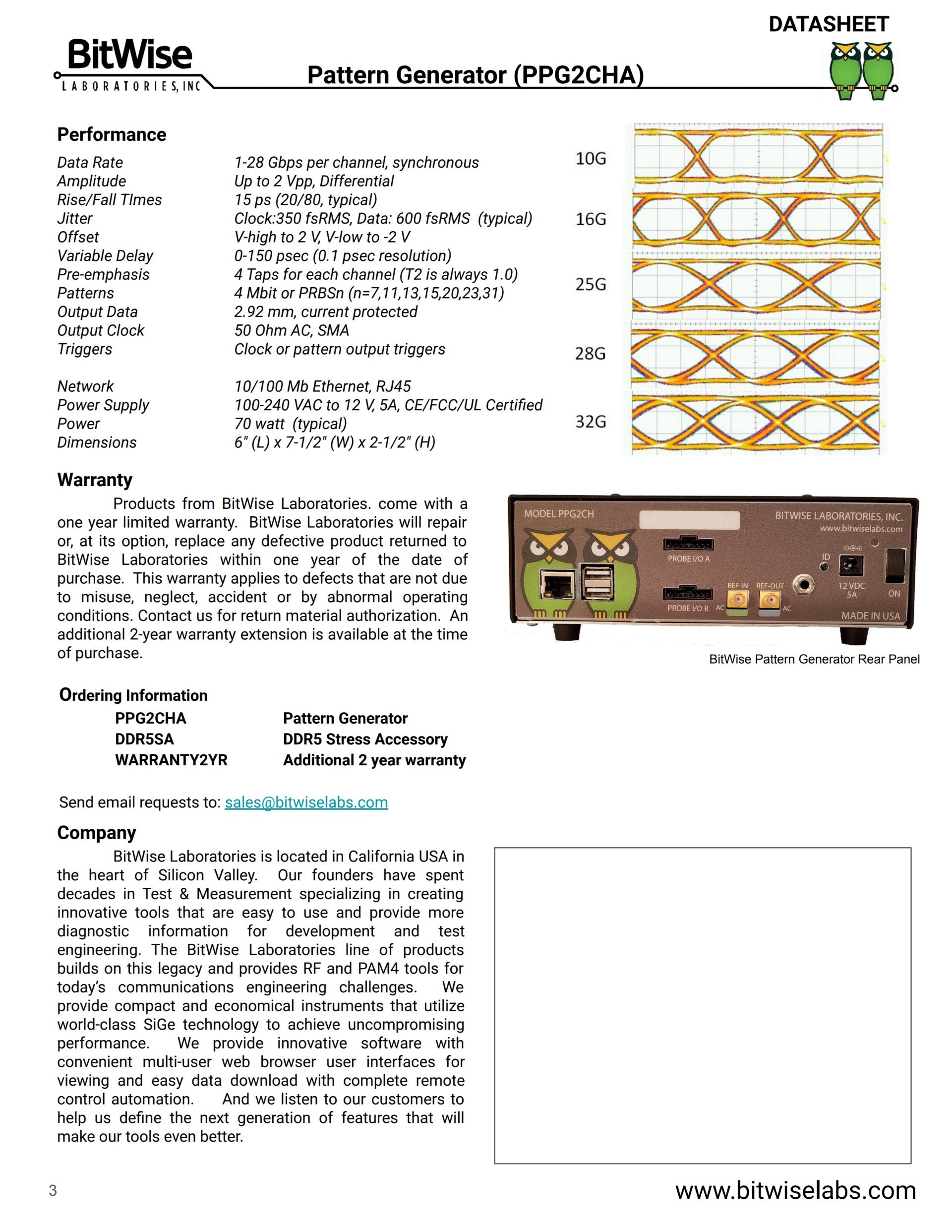
- 1.0 – 28.0 Gbps (32 Gbps option available)
- 2 synchronous NRZ data channel outputs
- 1 clock output
- Use differentially or single-ended
- Internal synthesizer or external clocking
- 4 tap pre-emphasis
- PRBS or user-specified patterns
- Bit-Interleaved or unlinked channels
- AC or DC coupled data outputs
- Programmable signal levels
- Optional stress accessory (PPGSA)
- Compact Design
The Pattern Generator creates data patterns used as stimulus for developing and evaluating digital communications systems and components. The Pattern Generators offers flexibility to create data streams of varying PRBS or user-defined patterns, with selectable data rate,, timing and pre-emphasis to help you create the test signals you need.
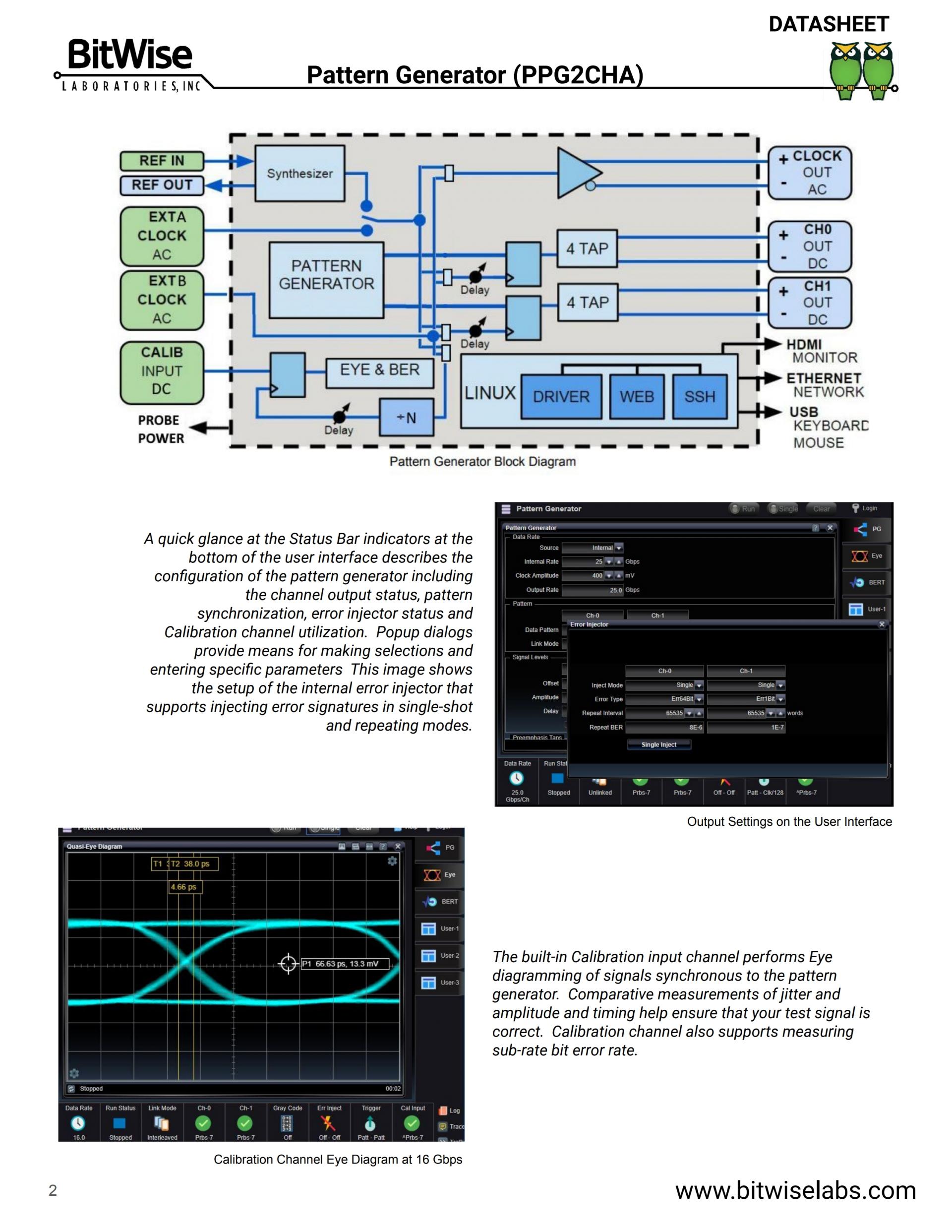
The Pattern Generator is a compact instrument that uses a built-in synthesizer or accepts an external clock input that is used to generate two channels of NRZ data at rates from 1.0 up to 32.0 Gbps each (28 Gbps is standard). Variable output delay is available on each channel for precise phase alignment. Each channel is DC-coupled and supports 4 Tap pre-emphasis with differential amplitude up to 2 Vpp. Channel pattern sequence output can be synchronized to combine properly to form a higher speed 2:1 multiplex.
External triggers can be used to trigger your oscilloscope on clock- or pattern-based triggers. A built-in error injector with selectable error profiles enables creating single-shot and repeating error signatures.
The built-in calibration input provides sub-rate error detection that allows you to examine eye-diagrams and BER Bathtub analysis for sub-rate return channels. This is perfect for use with applications that utilize a sub-rate loopback for receiver testing, such as DDR5.